EEG · TÜBİTAK 2209-A · IEEE CoDIT 2026
Investigating the Effect of Sustainable Product Packaging on Consumer Behavior Using EEG Signals
We compared EEG responses to wood-fiber and glass bottle images from 56 participants. The TÜBİTAK 2209-A supported study was published at IEEE CoDIT 2026.
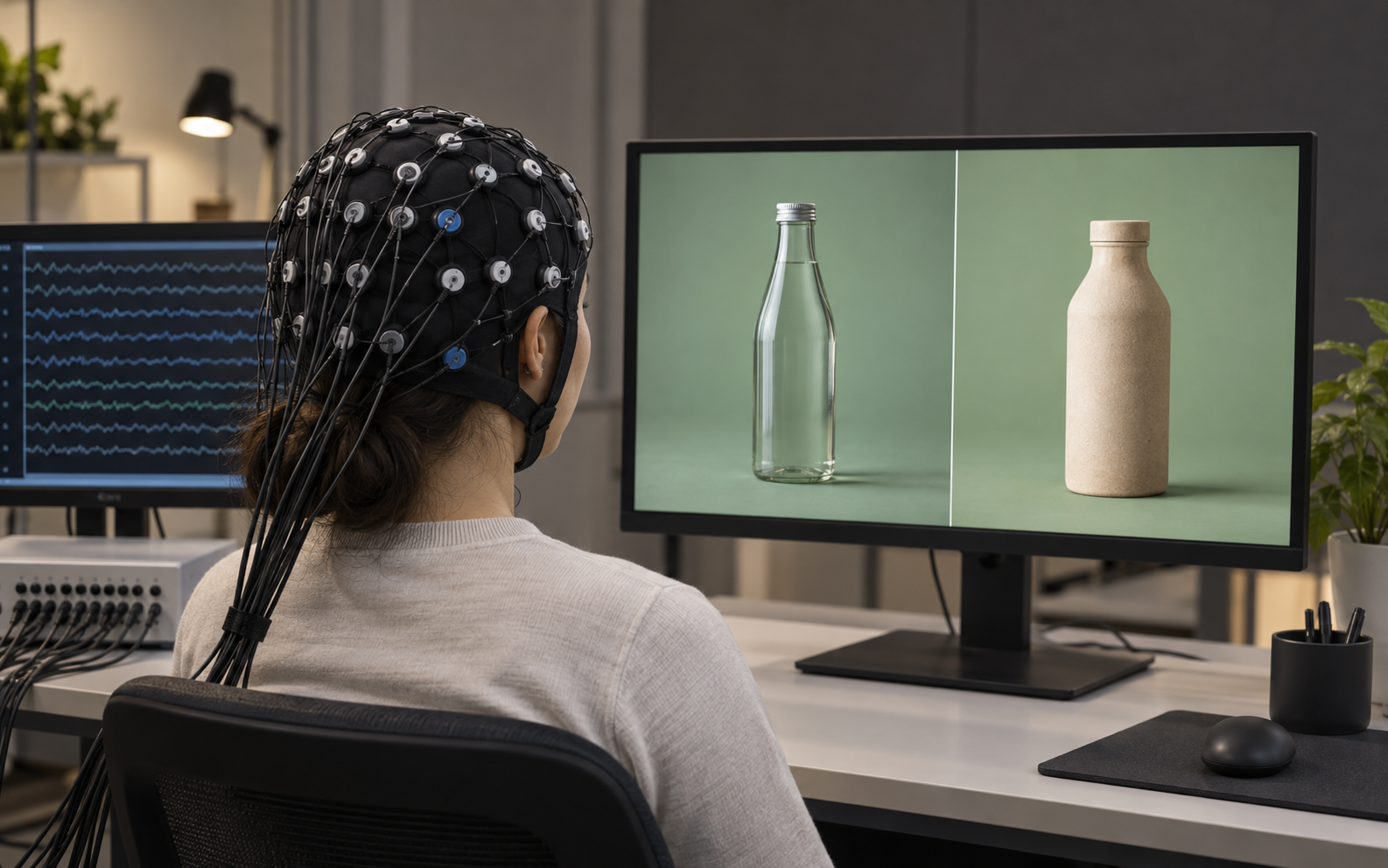
Two packages, one question
Do images of a wood-fiber bottle and a conventional glass bottle evoke different emotional responses? We studied EEG recordings through valence and arousal. Sixty volunteers took part; recordings from 56 remained after data-quality checks.
From signals to classes
The 32-channel recordings were filtered, cleaned with independent component analysis, and segmented into four-second windows. We extracted 896 time-, frequency-, nonlinear-, and entropy-domain features, selected 30 with ReliefF, and compared models for four valence–arousal classes.
What we found
The paper reports the highest test accuracy with a Subspace k-NN ensemble: 94.4% for the glass condition and 90.7% for the wood-fiber condition. SHAP analysis highlighted nonlinear features such as fuzzy entropy and Hurst exponent. These figures describe this dataset and protocol, not general product performance.
Scope and limits
Participants were university students under 25, and only visual stimuli from two packages were tested. The study did not measure touch or actual purchase behavior. The research page links to the published paper through its DOI.